


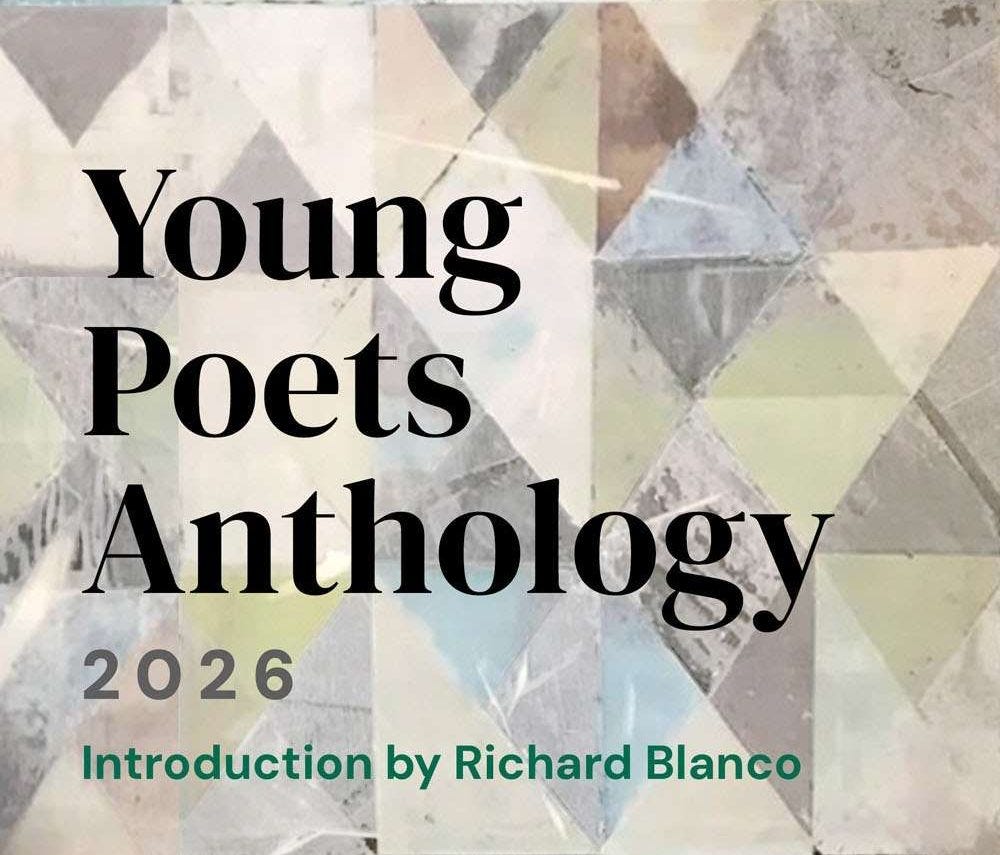
My ongoing gratitude extended to the amazing team at The Good Men Project. I’m proud to share this meditation on what the 1455 Young Poets Anthology meant to me personally, and why I think it’s not only a vital and timely addition to our literary landscape, but a genuine antidote to much of the confusion and despair we are reading (and feeling!) so much of these days. Poetry can’t solve our problems, but it can begin dialogues and help connect people who want to see meaningful and inclusive progress!
Friendly reminder that the 1455’s Young Poets Anthology is now available everywhere! I welcome you to support & spread the word!
Publishing young poets saved my life.
I thought more than once about the potential hyperbole of this statement, and then I realized: duh, art has been saving my life for decades now.
Hyperbole? We, as authors, creatives, advocates, and anyone who has turned to music or movies or books when no one else seems to be speaking or listening, don’t talk about this often enough.
So: publishing a book featuring poetry by almost 200 young writers from around the world, an ostensibly thankless, costly, risky endeavor, turns out to be almost entirely selfish. I’ll stand up and be counted. I couldn’t count the ways art has been there for me: as a surly but sensitive teen, as an ambitious but often oblivious graduate student, as an aspiring novelist who had to learn the hard way that it takes years of bad writing to possibly write something publishable, as a cube-dwelling denizen who harbored artsy thoughts but was smart—and lucky—enough to pay the bills via the so-called “real world.”
And now, as a nonprofit founder, writer with several books under my belt, and mostly an American who looks around and finds little to point to but consolidation, corporations and the real elites suffocating both the ways and means of original content, politicians in thrall to money and power, and a free press increasingly supine and either unable or unwilling to speak truth to the usual suspects, I have stayed out of the abyss by getting busy.
The purpose of what I do at 1455, an endeavor whose mission is simply to celebrate storytelling and promote creativity by any means necessary, is to carry a modest torch.
After 2024, my activities as a professor, founder, and poet left me feeling like I wasn’t doing enough. Not only for the cause, but to distract myself from the ceaseless stream of awful news, the feeling of helplessness as a relative handful of bad guys (it’s always guys) slice up the spoils while wages stagnate, opportunities disappear, the Humanities become chop shops for opportunistic and misguided cynics, and AI threatens to suck up the last bit of energy and attention inside an overwhelmed publishing industry.
During the last decade, 1455 has featured annual story festivals, boasting panels and individuals in conversation, promoting and celebrating the work they do. My favorite part of this labor of love was always the young poets contest, so it occurred to me, in the cold and chaotic early months of 2025: why not do something to put more beauty into the world?
On one hand, I knew nothing about publishing books. On the other hand, as a former tech analyst and independent author, I knew everything about this process—at once archaic and ever-changing. Anyone can, theoretically, turn a manuscript on a computer into a book available around the globe. It just requires some time, suffering, and hope.
Hope, as it happens, was the theme of the free call for submissions. Poets 21 and under were invited to send us a poem dealing with what hope means today.
I was expecting some good work. I was not expecting to be changed by it.
What I repeatedly encountered were young writers wrestling with loneliness, grief, uncertainty, family, identity, violence, love, and belonging. They are not naïve about the world. In fact, they understand perfectly well the chaos they have inherited. Yet what surprised me most was not their anxiety, but their determination. These writers are rejecting easy cynicism and instead seeking meaning, explaining what hope means and where it can—and, right now, can’t—be located. These are poems not as performance but evidence that empathy matters and that apathy is not an option. This anthology acknowledges pain but refuses to surrender, to despair or the circumstances of the world they’re inheriting.
In his introduction to this anthology, the award-winning former U.S. Presidential Inaugural Poet Richard Blanco writes, “poetry allows us to enter and explore those spaces through which we learn to embrace the emotional complexities and contradictions of our lives, rather than run away from them.”
Adults spend a great deal of time talking about younger generations. We are self-declared experts at diagnosing them, critiquing them, worrying about them. Perhaps to absolve our own culpability, we tend to dismiss them as being distracted, disconnected, disengaged.
Then I spent months reading their poems.
The experience I’ve had, spending time preparing this anthology, reminds me that art remains one of the few places where people can still speak honestly. With urgency but also grace these poets describe what they fear and what they love. I recognized anger but not blame, and I was inspired to learn the ways and means these writers believe hope is not only possible, but imperative.
Perhaps that’s why this project saved me.
Not because poetry necessarily solves sociopolitical problems, nor can a single book begin reversing political dysfunction, economic inequality, technological disruption, or our growing cultural exhaustion. But because these writers reminded me that imagination and curiosity still exist. Above all, compassion still exists and therefore, hope still exists.
The 1455 Young Poets Anthology began as an effort to publish and promote emerging writers. Somewhere along the way, it became something else: a reminder that creativity remains one of the most powerful antidotes to despair. Percy Bysshe Shelley famously called poets the unacknowledged legislators of the world. They can’t be expected to save us.
But they can show us the way forward.