

Director’s Note
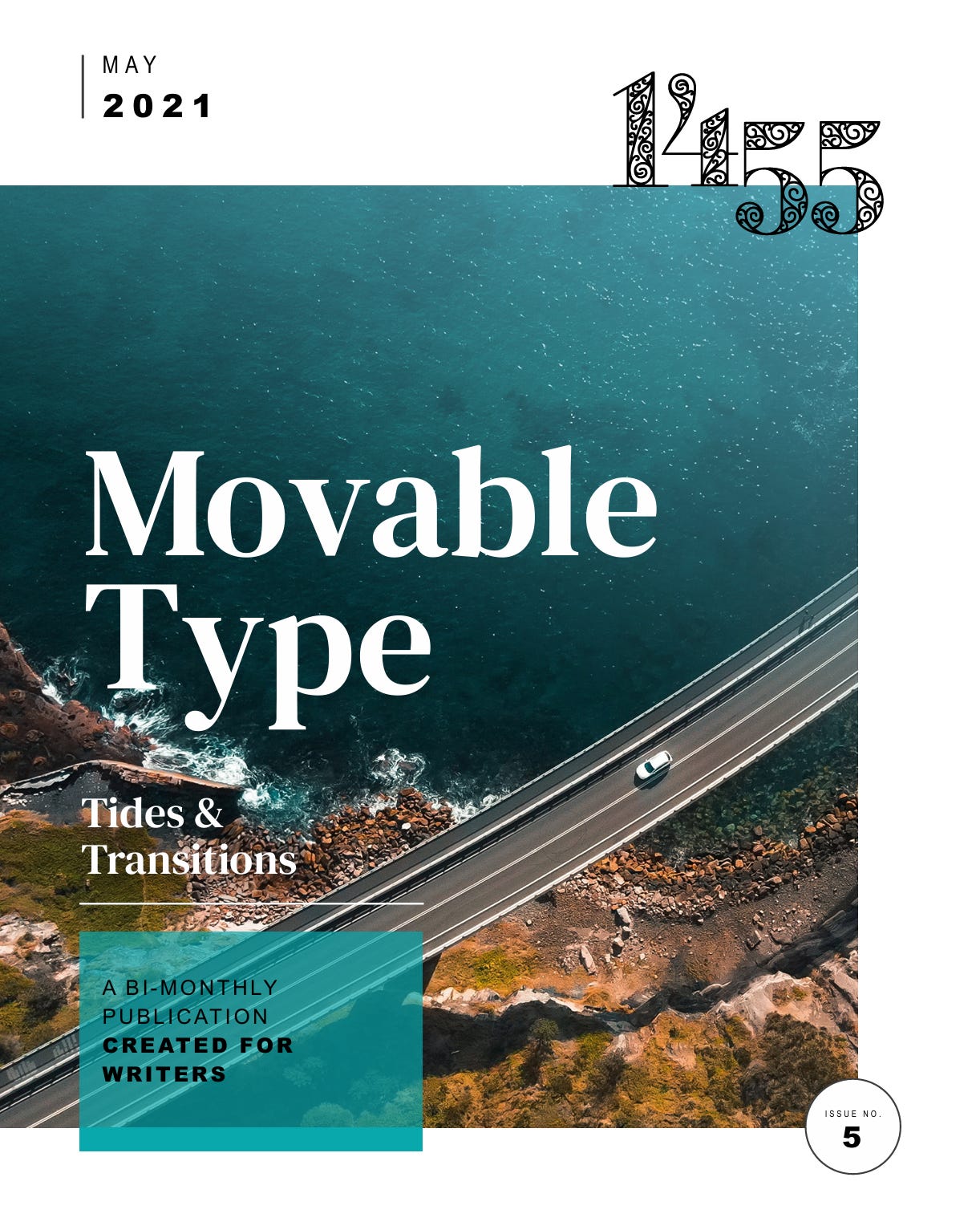
When we began kicking around possible themes for the fifth issue of Movable Type, we all had transition on our minds. Winter seemed to have made its last stand (though in D.C., you never know) and the warmer weather portended the return of vitality and, with more people getting vaccinated, a good reason to be out and about. It’s also been a heavy year, filled with disruption, adjustment, and a growing sense that we won’t be returning to what we consider normal. As with any type of change, it’s complicated, but there’s reason for optimism: trying new things means moving on from things that wanted improvement. As writers know, revision is everything, and a final draft seems forever like Ahab’s white whale: elusive, an illusion, tantalizingly out of reach.
We started to circle around the idea of coastlines, real and imagined. The tides are all about transition; what happens on the shore signifies both ecological and emotional matters. For those worried about the world and what we’re doing to it, the waters get quite deep very quickly. Looking back at what will be documented as an extraordinary year in human history, it’s hard to know exactly how to feel. We’ve celebrated sacrifice and innovation; we’ve also suffered through incompetence that staggers the imagination, and defiance of civility (not to mention reality) that might drive one to despair. The loss of life, on a global scale, has been intolerable. Nevertheless, we persisted.
This issue of Movable Type is, by design, a series of explorations that range from serene beaches to unquiet minds. It’s an investigation of our place in history, the state of our planet, and why, no matter what happens, those left behind must bear witness and carry on. Our Featured Writer is Dara McAnulty, and we’re honored to showcase an excerpt from his memoir Diary of a Young Naturalist (Winner of the Wainwright Prize), which combines a passion for nature and a commitment to activism and awareness. Melissa Scholes Young takes us to Hannibal, Missouri, and her essay “Flood Stage” examines some of what’s lost and all that might return when water overruns the land. Jessi Lewis acclaims the Outer Banks, and throughout “Promise on the Tide” we appreciate why she loves Avon, North Carolina, and how she’s already preparing—however resignedly—for its inexorable destruction. To be in a locale and worry if it will be there for future generations is no longer the stuff of science fiction or political debate, it’s the not-so-brave new world we’re bestowing to our children’s children. In the piece “Just a Normal Freak,” Sarah P. Weeldreyer interrogates normalcy, isolation, and the journeys (literal, f igurative) her panic attacks have taken her on, and how she’s learned to navigate an occasionally unfamiliar world in her own authentic way. For a fitting and elegiac finale for this issue, Beth Ann Fennelly, poet laureate of Mississippi, lovingly tells the story of her mother-in-law, who epitomized a kindness and a service to others that seems sadly quaint in a culture where we’re too often the center of so many stories we’re always telling (to and about) ourselves.
Immersed in this writing, I found myself at times informed, infuriated, and inspired, which seems just about right. I also kept recalling the legend of King Canute and his imperious attempt to repel the tides. In simpler times, this allegory spoke succinctly and indelibly to man’s hubris, as well as our impermanence. Today, the perverse synergy of our action and inaction (all we do, all we’re not doing)—driven by greed, abetted by denial—suggests a profound disconnect between the world we imagine and the one we’re busy creating, in our image. Once again, we must find the words that lead to action, cognizant that both change and hope begin inside our minds and hearts.
Join Our Community
At 1455, we believe story connects, heals, and transforms. If you share that belief, we invite you to subscribe to us here on Substack for new interviews, essays, and events celebrating the creative community.
1455 Needs Your Support
Your support helps us keep all 1455 programs free and accessible—please consider making a donation to sustain our mission and amplify diverse voices around the world.
Follow 1455
Website: 1455litarts.org
Instagram: @1455litarts
Facebook: facebook.com/1455litarts
X (Twitter): @1455litarts
YouTube: 1455 Literary Arts Channel
LinkedIn: 1455 Literary Arts